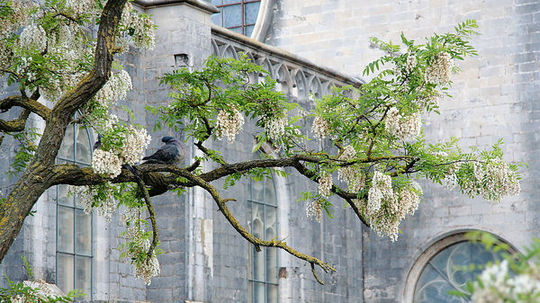
The most merciful thing in the world is the inability of the human mind to correlate all its contents.
H. P. Lovecraft
I cover the waterfront

Some rights reserved by estorde (http://www.flickr.com/photos/estorde)In a few days, I will be on holiday in Tignes. So no e-mail will be answered, phone probably neither. If I recover quickly ;-), I will come back to you after February 6th.

In the past weeks I have been working on a cleanup of the NJBG site. Some people volunteered to maintain the site. Since we are talking about a youth association, this is probably a good thing.

One of the lasts hacks I did was a mailing list. Actually multiple mailing lists with a web frontend. Although it is not really solid yet, it basically works. With PHP, programming is actually too easy these days. I needed only one procmail line (to redirect the incoming mail to PHP) and about twenty lines of PHP code. That is it. After working with python for some projects, it struck me again how good the PHP documentation is. Associative arrays (called dictionaries) in python still are a small mystery for me. Where PHP has a lot of nice array_ functions, python provides me with .keys(), .items() etc. methods, which make live hard. I really prefer handling with the keys and values in the same abstraction depth. Perhaps this is the reason mailman is such a monstrous beast...

-- Filed under:

Posted by jochem on 2005-01-25, last update on 2005-01-25
Let's party

Where november was the month of moving, december was the month of party's. Today I will combine these events in giving a house-warming/new-year party. After that (hopefully) more time will be available for some good old hacking. As a reminder for myself to fix the damned end-year-bug here a shell script which shows my calendar, created with this nice vim script in a year/month/day.cal format.

    dir="$HOME/diary"
    nrofmonths=2

    year=`date +%Y`
    month=`date +%m| sed -e 's/^0//g'`
    day=`date +%e`

    for ((i=$month; i <= (month+nrofmonths-1); i++)); do
	if [[ -d "$dir/$year/$i" ]];  then
	    for ((j=1; j <= 31; j++)); do
		if [ "$i" -ne "$month" ] || [ "$j" -ge "$day" ]; 
      then
            bestand="$dir/$year/$i/$j.cal"
		    if [ -e $bestand ]; then
                size=`/bin/ls -l $bestand | /bin/awk ' print $5 '`
		        if [ $size -gt 0 ]; then
                    echo -n "* `date -d "$i/$j" +%a\ %d\ %b` : "
                    sed -e "1!s/^/	       /g" "$dir/$year/$i/$j.cal" 
                fi
		    fi
		fi
	    done
	fi
    done

Happy 2005 anyone!

-- Filed under:

Posted by jochem on 2004-12-31, last update on 2004-12-31
Mystery man

Added an interview (wrote it already, so why waste it ;-)) on this page about the NJBG.

-- Filed under:

Posted by jochem on 2004-12-30, last update on 2004-12-30
From classical music to pop song

Introduction

Some rights
reserved by wakalani (http://www.flickr.com/photos/wakalani/) Pop and rock songs often borrow some parts of melody, rhythm or harmony of classical songs. When listening to (pop) music I sometimes notice, but later almost always forget the connection between the song and the classical piece. Since knowing useless facts can be fun, I have decided to write these "classical covers" down. On this page you can find my (very incomplete) list.

By no means do I want to judge the quality of the songs. I also do not condemn reusing music; reviving old masterpieces should be done more. Sometimes the original is better, sometimes the cover, and sometimes both are equally awful or heaven-sent; these subjective decisions are left out of this page as much as (humanly) possible.

It is very difficult to exactly pinpoint when a song is a "cover". Therefore I decided not to maintain a bare list, but also write a few words about the connection between the songs, ranging from a small theme or chord progression to a literary transcription in the same key. I try to mention the oldest occurrence in written music, which is very often from the Renaissance or Baroque, simply because mankind started most annotating around this time.

Feel free to contact me if you find mistakes, want to add something or have a question.

Music theory

Because in music theory everyone uses different terms for the same things, here I try to give a brief explanation of the terms as I use them.

Melody

Modes etc., blue notes, black/white keys.

Harmony

Guitarist are trained in reading chord schemes, like C-F-G, appointed with letters. These are absolute keys (actually they are not, but in modern times we kind of standardized on a=440 Hz, so I consider them absolute..). In this notation a C-chord consist of the notes c, e and g. This is a major chord. A minor chord (like c es g) can be notated in a lot of ways (Cm, c, etc.). I don"t use absolute notation here, so I do not have to choose.

I will use relative notation with I II III IV V VI VII as major chords and i ii iii etc. as minor chords. With this notation the scheme is related to the actual key (if the piece is in C, then I is the C major chord). I is often called the tonic, V the dominant and IV the sub dominant. In music theory there are often a lot ways to look at things. For example relative minor/major pairs consist of the same notes, but considered major/minor, because we accept a certain root key in it. (a minor and c major both only have whole notes).

Most theory "deals" with three note chords (triachonic(?). Of course it is no problem to play 2 or more notes together. Two notes are Lots of rock/metal music uses power chords (quint), which is played instead of the expected (usually) major chord. With distortion a power chord just sounds better and our mind fills the missed noted in automatically, so I will consider the "expected" chord.

When dealing with more than three notes, there is usually an explanation possible about the extra note (kept from melody, key, chord sequence or just belongs to the chord). C major is c e g, so if the fourth note is also a c e g, the chord is still c major.

Rhythm

3/4 etc. Change, off-beat, meters

Terms

modulation, stream, ostinato, hocket, rubato, ritardando, hemiola

The cover list

Pachelbel"s Cannon in D

     I > V > vi > iii > IV > I > V
     - Ralph McTell - Streets of Londen
     - Coolio - Gangsta"s Paradise 
     - Pet shop boys - Go West 
     - Demis Russos  - Rain and Tears 
     - Nocturnal Rites - Ring of Steel 
    

Beethoven"s Piano Sonata no. 14 in C#-minor (Moonlight Sonata)

     - The Beatles - Because (?)
     - Depeche Mode - Moonlight Sonata
     - Alicia Keys - Piano and I
    

Bach"s Air on a G-string (actually Orchestral suite no. 3)

     - Procul Harum - Whiter shade of pale
     - Yngwie Malmsteen - Air
    

Bach"s Bourree in G-string

     - Beatles - Black bird (saw mcCartney telling this himself) 
     - Jethro Tull - Bouree (Barre says in an interview that he learned 
          it from a music student upstairs (he can"t read notes))
    

Bach"s Tocatta and fugue in dm

     - Toy Dolls - Tocatta
    

Barber - Adagio for Strings

     - William Orbit - Adagio for strings
     - Skip Raiders  - Another day
    

Mozart - Requiem in d minor - Lacrimosa

     - Rank 1 - Sensation Anthem 
    

Ravel - Bolero

     - Gerard Joling - No more bolero"s
    

Saint Saens - The swan

Chopin - Piano Sonata No.2 in Bb minor

    - John Williams - The imperial march (Star Wars)
    

Various - La Folia

    - Vangelis - Conquest of paradise
    

Rachmaninov - Piano concerto no.2

    - Eric Carmen - All by myself
    

Feel free to contact me if you find mistakes, want to add something or have a question.

Links

.

-- Filed under:

Posted by jochem on 2004-12-30, last update on 2004-12-30
Back for good (?)

I am connected to the internet again (after a month leave), so expect more later.

-- Filed under:

Posted by jochem on 2004-11-20, last update on 2004-11-20
<- older entries | newer entries ->